Cyberlearning:Speakers

From Cyberlearning

Jump to: navigation, search

Cyberlearning-montage.jpg


Todd Rose, CAST

Toddrose.jpg

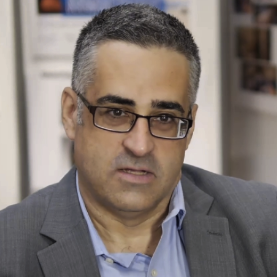
In Cyberlearning, "Cyber" is the Easy Part

Modern brain research has radically changed how we think about learning. Rejecting the myth of an “average” learner, this new view emphasizes the importance of natural variability and the role that context plays in shaping learning outcomes. In this talk, I will discuss what modern neuroscience has revealed about the origins of variability, and what this means for the way we design effective cyberlearning environments. The big idea for this talk is simple: Technology is easy, learning is the challenge.


.

Tom Moher, University of Illinois at Chicago

Moher-Photo.jpg
Moher-WallCology.jpg

Lightly marinating fifth graders in science phenomena

In designing science inquiry experiences for elementary school classrooms, it is important to recognize their unique organizational characteristics and activity structures. Unlike their middle- and high-school counterparts, self-contained elementary school classrooms house communities that are “captive” for long periods in a single space, affording persistent access to and interaction with learning artifacts and a stable group of peers, and (frequently) more flexibility in the allocation of time among curricular subject areas. Moreover, the activity structures in elementary school classrooms are more frequently oriented toward physically movement and whole class interaction than among older learners.

In this talk I will describe a design framework that seeks to leverage these characteristics of the elementary school classroom in support of kind of science inquiry that is only infrequently accessible to young learners: a “patient” science involving the investigation of phenomena that unfold slowly over a time course of weeks and requires the collective contributions of the whole class as a knowledge-building community.

The key innovation in this design framework, “embedded phenomena,” lies in its unorthodox use of classroom time and space. Learners are asked to imagine that their classroom is the site of a dynamic spatial phenomenon scaled to “fit” the extent of their classrooms. Students are afforded observational and manipulation access to the phenomenon through location-dependent “portals” (fixed or mobile compute/display platforms) reflecting the mapping of the phenomenon to the space. The phenomena run asynchronously with respect to the regular flow of instruction, and are displayed continuously over the course of weeks. Within this framework, students collectively develop and investigate questions, collect and aggregate evidence to address those questions, and (in the case of experimental units) manipulate those phenomena to effect specific outcomes.

The talk will include a brief recount of our experiences using this framework in classrooms, including recent efforts with collaborators to extend the framework to accommodate both real and simulated phenomena and to design complementary technology-based supports for teachers and learners in enacting units employing the framework. I will conclude by suggesting how emerging technologies might further enrich the activity structures afforded by this framework.

Jodi Asbell-Clarke, TERC

AsbellClarke-Photo2.jpg
AsbellClarke-Screenshot.png

Game Designers: A New Breed of Educator

The foundation of today’s educational system is breaking­–learners are falling through the cracks. Schools are using curriculum and teaching models developed for a past industrial age while learners need tools and pedagogy for today’s information-based workforce. In science, learners need inquiry skills focusing on creative, and collaborative knowledge building. This type of learning is happening in the Internet, especially in social games. In many online learning communities, including social games, knowledge building is decentralized and distributed. People collaborate together to solve fictional epic quests in World of Warcraft and find cures for real diseases in FoldIt. In a well-crafted inquiry game, players can spend hours drawing on information from Internet resources to help contribute to the knowledge of the community. Together they build, share, test, review and revise their ideas, based on evidence they’ve gathered in the game. They use peer review to gain consensus and as players collaborate they take on new roles and identities. These gaming behaviors have an intriguing similarity to practices in professional science communities.

What if educators and game designers can build on this overlap to make games that immerse players in scientific inquiry – games where their survival in the game depended on increasingly complex understanding of scientific phenomena? Imagine placing this valuable resource of learners’ time, curiosity, and passion in the hands of creative and experienced science inquiry educators! This idea calls for a new breed of educators – designers and choreographers of game-based learning environments. These educational game designers launch compelling narratives along with rich with tools and resources for scientific inquiry, and facilitate games that are nimble and responsive to the community’s growing knowledge. They embrace players’ creativity and innovation. A clever educational game designer relies upon the player community to guide the storyline and the knowledge building while providing seamless and invisible means of support.

Gameplay itself can serve as supportive instruction. Games such as Portal scaffold learning of highly sophisticated game mechanics with very little instruction. In social games and affinity communities, instructions often comes from a few players’ trial and error and then word-of-mouth to other players. In alternate reality games, such as World Without Oil, the game design itself is a product of knowledge that is shared and distributed across players. This evolutionary and participative design is contrary to most learning environments, where content is prescribed by the curriculum and delivered from teachers to learners. But, where does the authority of knowledge lie in these participative learning environments? Is there a role for a “teacher” in a game? How can games support and scientific inquiry in ways that might dig deeper and reach more learners than school settings? Should games replace school curriculum? Or can games bridge formal and free-choice learning “hard fun” so that learners choose to spend them gaming time learning through scientific inquiry. The answers to these types of questions may provide keys to opening the doors of science to an entire new audience of industrious, innovative problem-solvers – gamers!

Doug Clark, Vanderbilt

Clark-Photo.jpg

Games Modulating Players' Interaction With Underlying Simulations

My talk will frame digital games as a medium for engaging and supporting players in constructing productive mental models for operating on the underlying constituent simulations. I would propose that digital games are to simulations as feature films are to animations. In this analogy, one might think of feature films as providing a narrative and structure for interpreting, understanding, and ascribing meaning to the animated sequences of which the film is comprised. In a similar manner, digital games provide affordances for modulating players’ interactions with the underlying constituent simulations in a manner that supports the player learning and coming to understand the underlying constituent simulations. The difference is that many popular Hollywood films are not particularly intellectually challenging. Most popular games (but not all), however, need to provide much more intellectual depth and challenge to be successful. At the same time, digital games need to support people in learning them -- companies that make games that people can’t learn go broke quickly. I will propose that games as a medium provide a number of affordances in service of supporting players in constructing productive mental models for operating on the underlying constituent simulations. The talk will then discuss design principles from our NSF and DOE work in terms of affordances. The focus throughout would be on helping players articulate the intuitive understandings they develop through playing a well-designed learning game in terms of formal disciplinary representations and understandings.

James Lester, North Carolina State University

Lester-Photo3.jpg
Lester-CrystalIsland.png

Learning and Engagement in Narrative-Centered Learning Environments

Because of the growing recognition of the role that affect plays in learning, affective computing has become the subject of increasing attention in research on interactive learning environments. The intelligent tutoring systems community has begun actively exploring computational models of affect, and game-based learning environments present a significant opportunity for investigating student affect in interactive learning. One family of game-based learning environments, narrative-centered learning environments, offer a particularly compelling laboratory for investigating student affect. In narrative-centered environments, learning activities play out in dynamically generated interactive narratives. These afford significant opportunities for investigating computational models of student emotion. In this talk, we explore the role that affective computing can play in next-generation interactive learning environments, with a particular focus on affect recognition, affect understanding, and affect synthesis in game-based learning.

More broadly, we will explore narrative-centered learning environments and consider how they can simultaneously support learning and engagement. Drawing on a series of studies with the Crystal Island learning environment, which features an interactive science mystery for STEM education for middle grade students, we will show how narrative-centered game-based learning can promote effective and engaging learning and consider the challenges of implementing narrative-centered learning environments on a national scale.

Chris Rogers, Tufts University

Rogers-Photo.jpeg
Rogers-Screenshot.png

SAM: Listening to Kid's Models with Movie Making

Most teachers currently decide what a child knows or does not know based on interview and written word. We have found that rarely tells the full story - and that giving children more avenues to tell us their understanding help draw a better picture of their knowledge.

SAM (Stop Action Movies) is software developed at the Center to allow teams of students to quickly and easily tell their stories through movies. We have seen students sharing and arguing more, stay engaged longer, and remember longer simply by changing the reporting medium (www.samanimation.com). We look forward to classrooms in the future where teams of students will be able to actively discuss, argue, and present their scientific opinions around authentic un-answered questions as a way to teach science and engineering (just like what is happening at the graduate level now).

Gina Chaves and Eric Hamilton, Alliance Technology Math and Science High School and Pepperdine University

Chaves-Photo.jpg
Hamilton-Photo.jpg

Creativity of Teachers and Peer-Student-Tutors through Digital Media at the Intersection of Content and Cognition

This talk illustrates potential large and important cyberlearning trends in education, involving shifts in assumptions about participation, identity, and agency in learning. It shares NSF and IES-funded research on teachers becoming active participants in the user-generated content revolution, and on new and powerful intergenerational dynamics as students come alongside teachers to collaborate in digital media-making. The advent of low-cost, easy-entrée cyber tools has placed within grasp fundamentally different participatory roles and identities for teachers. Teachers can now engage in a role never emphasized or expected of them, of creating original digital media for systematic classroom and out-of-school use. (Federal and state agencies devote research resources to fostering creativity in youngsters, researchers, instructional material and curriculum developers, and school system administrators. In contrast, there are no such resources devoted specifically to nurturing the creativity of teachers!)

This research (currently in mathematics) integrates media-making with state and national standards, moving far down the elusive path of reconciling accountability demands with teachers’ engagement in rewarding dimensions of professional creative activity. It also opens new doors for using mobile devices to support learning in the home and for creating locally and culturally responsive teaching artifacts. Over two years, teachers have shown deeper immersion and expertise in content, more reflective activity in anticipating and unpacking student misconceptions, and greater care, coherence, imagination and subtlety in presentation. Given both permission to be creative and a design space with tools to do so, they develop high-level technological fluencies at the intersection of content, cognition, and creativity, devising inventive ideas for teaching challenging subject matter. Media-making sessions become deeply engrossing, in which teachers exhibit the characteristics of high-motivation, high-production flow states. These are all desirable characteristics of future learning environments.

Beyond evolving professionally in exciting ways, as teachers invite students to help them make media, they have opened up a new area of research that NSF is now supporting. The entrée occurs when a teacher asks a group of students: “Will you help me create media that will help your peers learn?” Teachers share that as students collaborate with them in media making, new and positive intergenerational dynamics consistently take hold. First, the students who are asked to help, change. They see themselves differently--as capable of helping carry out serious professional mathematical responsibilities. They see subject matter nuances differently, as subtleties not only to understand but to clarify to others through digital expression. They see the teacher differently. Their classmates see them differently. Student-tutors, like their teachers, formulate unanticipated and inventive moves. (As expected, participating student-tutor test scores rise significantly. The process of self-explanation in mathematics, for example, inexorably leads to higher performance on such measures.) The intergenerational dynamics of students and teachers collaborating in media-making has proven to be deeply motivating and transformative, affecting a cross-section of students. It furnishes a path to focus simultaneously and synergistically both on personalized learning and on nurturing a learning community, i.e. on personalized learning communities.

Leah Buechley, MIT

Beuchley-Photo.jpg
Beuchley-Screenshot.jpg

Art, Craft, and Technology

The aim of my research is to democratize creative computing—to introduce the tremendous creative and intellectual potential of computers and electronics to new audiences. I am convinced that cultural factors, more than a lack of aptitude, make engineering inaccessible and unappealing to many people, and I believe that by making technology more accessible and building computers and electronics that look and feel different from traditional ones I can begin to change and broaden the culture of technology. I can begin to get a diverse range of people excited by the ways that computers and electronics can be used to build beautiful, expressive, and useful objects that are different from anything that has been built in the past.

To achieve these goals, I blend “high” and “low” tech—integrating computation and electronics with materials like paper, textiles, ceramics, and wood—and then share these blends with others by designing and deploying toolkits. These kits allow diverse ranges of people to work with technology in contexts that they are interested in and excited about. The unorthodox intersections also lead to new kinds of technologies and new styles of working with and thinking about computers and electronics. In this talk I will introduce several of the tools that my students and I are developing and describe how they are impacting technological and educational communities.

Eric Klopfer, MIT

Klopfer-Photo.jpg
Klopfer-Screenshot.png

Mobile as a Creative Medium

The promise of mobile technologies to enable unique, creative learning experiences for everyone has existed for years. Limited interfaces, input methods and adoption postponed the realization of that promise. Yet, as those initial barriers have faded, the dream has not been realized. Instead, we face a perceptual barrier: many traditional educational media producers see mobile devices solely as a means to cheaply distribute text, tests, and routine activities along with rewards like animations. That said, pockets exist where mobile devices are being used for creative expression, innovation, collaboration, and meaningful engagement. In these largely user-driven cases, learning experiences are customized through intelligent technology design that allows learners to control their devices, rather than the other way around. These opportunities are now emerging both through student-initiated experiences (e.g. nearly instantaneous sharing of events through photo and video in social networks) as well as experiences designed for learning (e.g. citizen science opportunities for collecting and sharing geotagged data).

One example of such a creative learning experience that draws on the rich heritage of constructionist pedagogy from MIT is the App Inventor project. App Inventor is a graphical programming language that allows people with little programming experience to create their own Android apps. The software was originally developed at Google based on work from our lab, and is now being open sourced, with the lead role being brought back to the new Center for Mobile Learning at MIT, where I am a co-founder. In planning for this transition, I have learned about the diverse ways in which learners that range in age from 8 to adult have been using these tools to create and learn. For some, app creation has become another medium of expression, like video, photos, or drawing. For others, it has been a way to invent solutions to problems that they face in their schools, classes or communities. And yet others have used it directly in classes to foster learning about particular concepts. The App Inventor experience has benefits not only for the creator of the apps, but also for their target audience (often the creator’s friends, students or classmates). Instead of a general experience designed for masses, the audience gets an experience tailored by someone who knows them and sees that creating an app is something that they too could do.

One of the promoted benefits of mobile learning, is the “anytime anywhere” experience, which does indeed have value. However, today’s mobile devices are not just mobile, but context aware. This enables “here and now” learning, in which the current place and time are deeply linked to learning. A number of researchers (including our group) have been developing location-based (“augmented reality”) games for learning, which explicitly connect students to real issues in their communities through both play and creation of these games. As technology and design progress, I expect these two modes of interaction to blur, so that playing, contributing content to, and creating games all become part of one process.

Paulo Blikstein, Stanford

Blikstein-Photo2.jpg
Blikstein-FabLab.png

One Fabrication Lab per Child: Why Making and Building can Bring STEM Learning into the 21st Century

There are two “bugs” that prevent us from giving students a better experience in learning STEM – and we can take bold steps to improve and scale it up using cyberlearning tools. The first bug: we need better spaces. Traditional school content is very well adapted to the constraints of the classroom, so just as in any evolutionary process, the fittest survives. Schools teach the curricula that survived the classroom. Now imagine a school without a gym – no matter how important you think sports is, there is no way to do it without the right space. If you try, you will soon realize it is not very productive, and you will drop it from the curriculum. That’s exactly where our schools stand in regards to “21st century” STEM skills, such as innovation, creativity, making, building, and critical thinking: we don’t have the right place for teaching those skills. It is quite challenging to learn them in 40-minute blocks, in a room with chairs and a whiteboard. Instead of fitting all this new content within these difficult constraints, I am proposing starting from scratch, building a new kind of space specifically designed for science and engineering. I call this experiment FabLab@School, but this is not about my project -- I envision many other kinds of spaces that we as a community will have to build in the next 10 years – and hopefully schools will become a collection of labs.

The FabLab@School is a hybrid space between an advanced science lab and a full-blown rapid prototyping facility, with 3D printers, laser cutters, robotics, and advanced sensors. I will describe why and how they work, and how “making” and “building” in these special spaces can reshape science and engineering in our schools, not as an “enrichment” or after-school program that just a few can attend, but as a centerpiece of students’ lives, not only for the few who can afford, but for everyone. The most popular K12 engineering programs – national robotics or science competitions –– have become high-stakes events where only a few succeed and participate. Competitions are the wrong way to promote inclusion, and we need to change that. For example, using cyberlearning tools, we are connecting labs in different countries to promote collaborative problem solving around meaningful social issues. Kids in Russia, India, and the US could invent a new water filtration device or an energy saving heater – so engineering become real and important.

The second bug: assessment and evaluation should fit the task. The history of our field has too many good ideas that died a premature death due to the lack of research instruments that were well adapted to the task. There are many learning analytics techniques that we should be using for assessment and evaluation of open-ended tasks in these labs. For example, in my lab, we capture minute-by-minute actions when students program a robot or build a device, and then use algorithms to identify learning patterns. We have never had a combination of cheap fabrication tools, a strong culture around “making,” novel assessment techniques, and an acute sense of urgency around STEM education. This combination will enable us to convince policymakers, principals, and teachers that, this time around, we have better hopes of promoting sustainable change to STEM education.

Jennifer Frazier, Exploratorium

Frazier-Photo.jpg

Visualizations are the New Microscopes: Creating Scientific Learning Tools for Learners in the Petabyte Era

Museums and other learning environments have long used visualizations to show the public things they can’t normally see, such as the birth of a star or the structure of DNA. But visualizations are an increasingly critical medium for science museums. As the volume of data collected by scientists expands exponentially in what's becoming known as the "Petabyte Era," visualization is the tool that allows them to make observations or detect patterns. Whether comparing genomes, mapping the structure of a virus, or developing new models of Earth’s climate, most scientists now do some – if not all – of their work using visualized data.

The growing importance of visualizations in science presents an exciting opportunity for museums and other learning environments. Scientific visualizations can provide stunning images, engaging the public with phenomena they've never seen before. Visualizations can be displayed on large, dynamic interfaces, providing new ways for the public to participate in interactive, social learning. Visualizations can also be used to create authentic tools for the public to make their own discoveries, analogous to microscopes or telescopes. But to create visualizations that are meaningful for learners a number of challenges must be addressed. Visualizations must account for a learner’s level of content knowledge, lack of familiarity with visual representations used in science, and their limited time.

These challenges must be addressed for museums and other informal learning environments to bring current science – and critical new scientific tools – to the public. This talk will highlight the critical role educational research and collaborative development play in creating successful visualizations for learners by presenting several case studies, including the Exploratorium’s NSF-funded Living Liquid project. This talk will also present a vision for how support from large institutions and funding agencies could advance visualizations not only for science learners, but for scientists as well.

David Kanter, New York Hall of Science (NYSCI)

Kanter-Photo.jpg
Kanter-Sciplay.jpg

SciGames: a Technology-enhanced Model for Bridging Informal and Formal Science Learning

The PCAST report on K-12 Education in STEM for America’s Future calls for better integration of informal and formal science education. Behind this call is research showing the positive impact of informal environments such as science-technology centers on students’ science affect, but little impact on their knowledge of science concepts. At the same time, while inquiry-based lessons are known to improve students’ knowledge of science concepts, such formal instruction has shown limited positive impact on affect, including for students from ethnic/racial groups underrepresented in science and engineering careers. This call to better integrate informal and formal science education reflects the need to improve both science affect and learning to introduce and retain more- and more diverse- students in the pipeline to science and engineering careers.

Emerging technologies can build new types of bridges between informal science-technology centers and formal science classrooms, which are integrable into existing infrastructures in both environments, while at the same time capable of improving science affect and learning. The SciGames Model uses technology to make a serious game out of students’ interactions with existing exhibits. To positively impact affect, the resultant game has to be genuinely fun to play. At the same time, using the target science concepts must be integral to winning. In one example, sensor and data acquisition technologies were used to enhance a slide exhibit at the New York Hall of Science. Students choose a pad on which to slide and then step on a scale. A computer processor talks to the scale and a pair of photogates at the top of the slide to calculate students’ initial potential and kinetic energies. Students’ choices in how they slide change and interconvert these initial energies into thermal energy from friction and more kinetic energy (per a second pair of photogates) by the bottom of the slide. These energies and how they are interconverted are displayed as the rise of a virtual hot air balloon and the turning of its propeller. Students collaborate to induce qualitative scientific relationships that they can apply to get the balloon to reliably hit a target each time they slide. Student affect and learning outcomes of this pilot will be shared.

The SciGames Model also anticipates the uses of other emerging technologies. Students can wear radiofrequency identification bracelets, which automatically log all students’ individual data while playing the games. This data can later be uploaded to a digital app, and back in the science classroom, students can use this digital app to continue to play the game, reviewing their classmates’ data and collecting new data to discover quantitative patterns and formalize the science concepts. Ultimately, this technology-enhanced model can be used to create games out of many exhibits that do little more than illustrate scientific phenomena. This model can support inquiry that begins during the 10.9 million annual student visits to science-technology centers and then continues back in science classrooms. The same suite of technologies can be used to bridge formal science to other informal science learning contexts beyond museums.

Matthew Easterday, Northwestern

Easterday-Photo.jpg
Easterday-Screenshot.jpg

Cyberlearning for the New Civics

Nuclear proliferation. Environmental destruction. Poverty. We now face the most serious problems the world has even seen. Can cyberlearning help us overcome these challenges? Perhaps, but only if we recognize that policy problems cannot be solved without an active, well-informed citizenry. And we cannot develop an active, well-informed citizenry without civic education. Cyberlearning can help us to address society's most urgent problems by creating learning technologies that promote an active, well-informed citizenry–one that can analyze policy, raise awareness by communicate issues, and act to make leaders implement policies in the public interest. Designing learning technology for civics requires us to work at many levels at once. It requires that we:

1. Develop cognitive models of the knowledge skills, and dispositions of the new civics, including how citizens (a) analyze policy arguments, (b) raise awareness of public issues through journalism and debate, and (c) organize for civic action.

2. Study the challenges learners face in acquiring these abilities. For example, university students should have the skills needed to comprehend basic policy information and to modify their beliefs in the face of contradictory evidence, but they do not.

3. Discover instructional principles for increasing learning and motivation. We have only recently begun building a knowledge-base of instructional technology principles, and we know even less about making instructional technology engaging.

4. Develop interventions combining tutors and games. We now have technologies that both radically increase learning (tutors) and are extremely engaging (games). Cognitive games like Policy World are able to teach skills of policy analysis in a way that feels much more like playing a video game than doing homework.

5. Develop curricula that engage students in the community. Cyberlearning technologies tutors and games can teach many of the basics, but to promote engaged citizens that can apply their knowledge to the real world, civics curriculum must take students out of classrooms and into communities. For example, after-school civic engagement that teach immigrant students to report on policy issues affecting their communities. Cyberlearning again has a role to play here through social-media that connect student-citizens to each other, and to their communities.

6. Develope infrastructure in order to distribute instructional technology and monitor student learning at scale.

With a solid evidence-base of civic learning, we can now imagine a future in which students learn about the challenges facing their society and develop the skills they need to face these challenges through playing games. Where they produce community journalism and connect with other like-minded citizens through social media. Where schools provide the infrastructure for them to become effective civic actors. Civic education is the democratic engine that allows us to overcome policy challenges. Technology alone will not solve our policy problems, but cyberlearning will play an essential role in the sweeping reforms of civic education that are necessary for our survival.

Curt Bonk, Indiana University

Bonk-Photo.jpg

Stretching the Edges of Technology-Enhanced Teaching: From Tinkering to Tottering to Totally Extreme Learning

Some insist. Some resist. Others persist. Such is state of online learning today. But what is highly resistible for some is often passionately irresistible for others. Many are content to tinker with blended forms of learning. They dip their toes into the technology change movement by embedding shared online videos, simulations, timelines, collaborative groups, and open access articles in their courses. Others enter deeper waters and push toward the edges of what is possible. Their classes are teeter-tottering on the brink of transformation. Such instructors hand over the keys to their learners and let them drive for a bit. These risk taking instructors might enjoy reading a learner-designed wikibook, listening to a student generated podcast show, or watching the results of an international video competition. And then there are those who find themselves at the extreme edges of this learning planet. They might tap into virtual explorers, artists, archeologists, and adventurers to excite their learners. It is in such courses that scientific discoveries appear live. Mobile, virtual, and telepresence technologies become the new norm. It is time to stretch toward the edges of learning from those of us tinkering on the shores to those whose learning approaches are tottering in new directions and even landing in totally extreme or alien lands. This talk will showcase examples from all three worlds - the world of the tinkerer, the totterer, and the totally extreme. In which world will you find yourself?

Elliot Soloway and Cathie Norris, University of Michigan and University of North Texas

Soloway-Photo.jpg
Norris-Photo.jpg

Education in the Age of Mobilism: The Inevitable Transformation of K-12 Classroom

The planet is entering headlong into the Age of Mobilism. The hallmark of this new age is connections: connections to people, to events, to places, to things – immediate, multiple, and simultaneous connections. The affordances of a mobile learning device, that miraculously-thin, aluminum-encased slab of glass that is essentially embedded in one’s hand, are engendering changes in beliefs, values, and practices in all areas of human endeavor, from accounting to zoological research – and even in K-12!

For the past 40 years or so schools have used computers – desktops to laptops, standalone to online – to “better” implement the existing curriculum – a curriculum that was initially design by the Committee of Ten to prepare students to enter Harvard -- in 1892. (It’s true – Google-it – you will see!) It took the business community 20 years or so to figure out that in order to gain substantive benefit from computing technology one needed to informate, not automate. That is, using the computer to “better” implement an existing business process, i.e., automate, brought only small gains; but when a business process was redefined to take advantage of the affordances of the technology then – and only then – did business see serious, substantial gains. Sadly, K-12 has yet to learn that lesson, generally speaking. But, we are here to report that some schools have figured out that that mobile learning devices afford students with new opportunities, i.e., informate, to learn and are indeed reaping serious benefits from their use (read: increased test scores).

In our presentation we will (1) describe the characteristics of this Age of Mobilism and we will (2) describe how those mobile devices are the catalyst in the transformation of the classroom from “I Teach,” a teacher-centric, didactic, direct instruction, 19th century, boring and ineffective pedagogy to “We Learn,” a student-centric, project-based, inquiry-oriented, 21st-century pedagogy.

Eric Schweikardt, Modular Robotics

Schweikhardt-Photo.png

Models of Complexity

All of the world's most pressing problems have something in common: a high degree of complexity. Political upheaval, environmental problems, networks; to understand them and make informed decisions, we need to be able to understand how systems comprised of many independent agents can create emergent behavior. We need to be able to look deeply at problems and understand the factors that combine to create larger patterns and effects. The ability to think critically in complex domains is the key to progress on hard problems, but the National Science Education Standards barely hint at the importance of complexity and emergence. The current polarized political climate in our country is one piece of evidence that we have failed at helping children understand and operate within complex systems.

When I write “complexity,” I don’t mean that kids should learn the math behind chaos theory or nonlinear dynamics; these abstractions of complexity are too rigorous. I also am not arguing for Gaia theory or holism; these examples are too specific and preloaded with controversy. I do mean that we must gain better intuitions of how patterns form and change and how networks react to certain inputs. I mean that we must improve our ability to switch levels of abstraction: to think simultaneously of both society and the individual people who are its elements.

To move forward as a species, we need to get better at designing solutions to problems in complex domains. We need visionary ideas and visionary solutions to big problems, and we need leaps forward. These leaps will be made by designers who effect real change in the world because they're able to take a detailed look at the small components of a system and simultaneously step back and see how the system interacts with the rest of the world. We can jump-start this way of thinking in young children by giving them models of complex systems that they can build and think with. They’re not learning equations, they’re building intuition, and intuition can be extremely powerful. Playing with LEGO, for example, doesn’t teach physics, but it provides the experience and intuition so that when physics is encountered later in life, it makes sense.

I'll present evidence of complexity's importance in several critical STEM areas. I'll show some early examples of models of complexity like StarLogo and Braitenberg vehicles, and I'll demonstrate how Cubelets, a modular robot construction kit that we are developing, provides several opportunities for children to build and manipulate complex systems of their own. I’ll discuss some observations on how children think about systems differently when building them versus taking them apart, and I’ll offer some ideas for the future of digital and physical models of complexity. Toys shape the way that we think about the world. I'll argue that playing with a pile of tiny robots can be an extremely effective way for kids to gain a deeper understanding of how real world systems evolve and change.

David Birchfield, Arizona State University

Birchfield-Photo.jpg
Birchfield-Screenshot.jpg

Embodied Learning: Tools, Techniques, and Implications

The growing field of embodied learning brings together emerging technology and contemporary research in the learning sciences. Years of cognitive research support the tenet that cognitive processes are deeply rooted and come from the body’s interactions with its physical environment. Glenberg (2010) contends that all cognition comes from developmental, embodied interactions with physical environments. It follows that all thought - even the most abstract - is built on the foundation of physical embodiment. This stance is supported by evidence that brain areas associated with long-ago learned concepts are still activated when humans think about those concepts, or tools. Pulvermüller (2005) found that when participants simply read the word for an action (“like, pick, kick”), the premotor and motor cortical area associated with that action became differentially activated. Glenberg has demonstrated that this research can be applied in the domain of learning, and has experimentally demonstrated that embodied action can be used to improve reading comprehension for young readers. At the same time, new modes of physical interaction are becoming increasingly pervasive. The most exciting area of innovation from human-computer interaction research is addressing new types of computing interfaces. This is evident in recent advances in the commercial gaming industry including the Nintendo Wii and the Xbox Kinect. We believe that these recent trends - viewed as a movement toward embodied learning - represent the next wave of technological innovation that will transform learning environments in the coming decades. In our own work we have developed a set of embodied learning environments (e.g., SMALLab and Flow) that use multiple systems for real time motion-capture. For example, in SMALLab, motion-capture technology tracks students' 3D movements via a handheld trackable objects as they learn in an immersive, interactive space. As students are learning about a physics concept like velocity, they can hear the sound of their actions getting faster. They can see graphs and equations that represent their motions in real time. They can feel the weight of an object in their hand as they interact in real physical space. We have conducted a series of empirical studies in K-12 schools that demonstrate the positive impact that this approach can have on student learning. We have also developed a set of design principles for embodied learning environments that can be applied to any technology platform. This talk will provide an overview of the field, present concrete examples from current research, and lay out implications and challenges for the field moving forward.

Wllliam Swartout, USC

Swartout-Photo2.jpeg
Swartout-Twins.jpg
Swartout-TwinsWithStudents.jpg

Learning with Virtual Humans

For over a decade, we have built virtual humans at USC’s Institute for Creative Technologies. Our goal is to create computer-generated characters that look, communicate and behave like real people as much as possible. Specifically, these characters are autonomous, thinking on their own. They interact in a fluid, natural way using verbal and non-verbal communication. They exhibit emotions, and do it all in a coherent, integrated fashion. They are perhaps the ultimate test for artificial intelligence. Initially, we thought virtual humans would act as replacements for human role players in learning exercises, but we now realize that the potential for virtual humans is far more profound: virtual humans are able to connect with real people in powerful and complex ways. Studies done by us and others have shown repeatedly that people respond to virtual humans as if they are real people. Computers are already great at dispensing information, and so by adding a rich array of social elements to the communication by using a virtual human, computers gain the ability to build relationships and establish rapport. This increases user engagement and sense of immersion. In sum, virtual humans have the potential to create an entirely new metaphor for how we interact with computers and this has important implications for education.

Some of our virtual human learning systems include: - The Twins: As virtual docents and STEM role models at the Museum of Science, Boston, the twins can tell visitors about things to do and even answer general questions about information technology and how they work. - Coach Mike: Also at the Museum of Science, Coach Mike helps visitors learn to program a robot. He helps visitors get started, gives advice if they get stuck, and celebrates their successes. Coach Mike may be the first intelligent tutoring system that actually enjoys his job! - SimCoach: Available online, SimCoach uses a virtual character to help returning veterans confront problems such as depression and PTSD by engaging them in a dialogue to find appropriate resources. While the information is similar to what could be obtained from a website like WebMD, the use of a highly approachable virtual character allows us to create rapport and lower the barriers to care. - INOTS is an interactive system designed to teach junior naval officers about how to handle personnel problems. A virtual character plays an enlisted sailor who has misbehaved. Counsel him well and the situation will be resolved; do badly and bad will go to worse.

Thorough evaluations of these systems show that people (1) respond to virtual humans as they would real people, (2) engage the task more deeply and in meaningful ways, and (3) gain knowledge based on what the characters convey. Although diverse, these systems are united by their use of virtual humans. Virtual humans open up new horizons for using computers in education. For too long, students have had to adjust their behaviors to suit computers; we believe it is time to turn the tables and make computers act more like people.

Bill Finzer, KCP Technologies

Finzer-Photo.jpg
Finzer-Screenshot.png

The Data Science Education Dilemma

The ongoing exponential growth of our society’s storage of and reliance on data is astonishing. The growing gap between the need for a data savvy citizenry and the data science education of students is equally astonishing, greatly troubling, and extremely perplexing. Looking just at K–12, meaningful student encounters with data analysis are rare, teachers’ data skills and comfort using data-driven lessons are nearly non-existent, curriculum developers’ motivation to weave use of data into classroom materials is extremely low, researchers’ efforts to build a knowledge base of how students learn about data are limited, and policy makers’ attempts to strengthen data science education in the schools are ill-informed. In the fractured landscape of school subject-matter disciplines, data science has no natural home. Mathematics, already uncomfortable housing statistics, resists the incursion of rich contexts that mess with students’ ability to focus on abstraction. The physical and biological sciences, steeped in experimental data as they are, are so overwhelmed with teaching concepts that data get relegated to the role of illustration. The social sciences, though increasingly data-oriented in practice, have hardly begun to adopt the quantitative perspective necessary to bring meaningful use of data to K–12 social science classrooms. The challenge then is to figure out how to change our educational system so that students emerge from their schooling with data science skills and conceptual understanding needed to participate fully in our society as citizens and workers. Approaches I’ll illustrate approaches to meeting this challenge with work I’m currently doing as part of an NSF DRK–12 project called Data Games and, in the process, delineate some sub-challenges. We’re working on web-based data analysis capabilities suitable for a wide age range and for all subject areas. This is based on prior work on two desktop learning environments—Fathom and TinkerPlots. I’ll use examples from this work to point out some unexpected opportunities and unsolved problems.

Cliff Konold, University of Massachusetts at Amherst

Konold-Photo.jpg
Konold-Museum.jpg

Data Visualization: Learning to See the Invisible

What are we currently doing in schools to prepare students to deal with a world flooded with data? Precious little. And what does occur there is mostly inadequate and falls woefully short of the 21st century skills required of "data scientists." Having students collect small data sets and learn to display them in hand-drawn pie and bar charts is comparable to teaching hand copying of manuscripts to post-Gutenberg monks. Along with the deluge of data, digital technologies have spawned a new set of data visualization techniques for detecting patterns in massive data sets, capabilities that take advantage of what our eyes do exceptionally well. There is a tendency, however, to talk about effective data visualizations as if they render patterns and trends obvious to anyone who looks at them. In line with this thinking, Hans Rosling has suggested that our job should not be to make "people understand graphs" but rather "graphs that people understand.” My work lies at the intersection of developing new educational technologies for data visualization and researching student thinking about data and chance. I and my colleagues strive to build both the dynamic graphical representations that people can more easily understand and also the people who can understand them. I briefly review research from our lab that contrasts how experts vs. novices visually scan simple graphs. This research suggests that underlying the expert's perceptions is a view of data as comprising two distinct components: signal and noise. Without this perspective, the important features of nearly any data representation remain virtually invisible. I will then demonstrate features and uses of our data visualization software, TinkerPlots, which we have developed to facilitate young students coming to perceive data as signal and noise. The features include a new simulation and modeling tool integrated into TinkerPlots' visualization capabilities that students use to construct realistic data in an attempt to model stable and variable features of real distributions.

Christine Greenhow, Michigan State University

Greenhow-Photo.jpg

Help from ‘Friends’: Social Network Sites & the Future of Cyberlearning

For the past five years, I’ve commented about the rise of social media, and technology-mediated social networks, across various demographic groups and economic sectors – business, government, journalism, fashion, and publishing – and, I’ve written about its transformative potential in these sectors outside education. As social media has gone mainstream, I’ve combed the learning, communication, and information sciences research databases, and contributed some of my own studies, to show evidence-based examples of how learners’ use social media, like youth-initiated social networking sites and social networking applications, to become more knowledgeable generally, scientifically literate, communicative, connected to and influenced by their peers, and engaged 21st century citizens. In this work, I’ve confronted a good share of resistance, evident in the popular media and educational circles, because social media and young people’s related practices are often seen at best, as a waste of time, and at worst, as harmful to academic learning, youth development and fundamental principles of privacy, safety, and intellectual property.

I am troubled by these interpretations being touted as fact, because I know that situating learning in technology-mediated social networking spaces and beyond, can profoundly impact how people develop scientific (and other) literacies and become informed and active citizens. Researchers and policy makers agree that increasing adolescents' science learning, technological fluencies and preparation for the 21st century work place are critical problems facing U.S. education. In addition, research continues to document young people's dissatisfaction with and disengagement from school and from public life. Engaging with contemporary STEM issues and practices in global, mobile, and socially networked contexts, that piggy-back on learners’ existing media ecology and routines, can prove fertile ground for developing and designing for modern scientific literacies and citizenship education: the issues are pressing, relevant to kids, and can help bridge school curriculum with students' out-of-school interests and communities. And yet, this is an area of cyberlearning research and development that is currently under-defined and therefore, under-funded.

This talk will argue for an agenda for cyberlearning research and development that is focused on the transformative potential of and vision for social media (with particular focus on social network sites and open source social networking applications), including (a) history and definition of this emerging technology, (b) transformative ways its being used in other sectors, and (c) selected examples from current learning sciences-related research that helps the audience envision its transformative potential. The talk will close with a related vision 10 years out and identification of two grand challenges that align with this vision and that build on the Grand Challenges outlined in the 2010 National Educational Technology Plan and previous Cyberlearning agendas.

Melanie Cooper and Mike Klymkowsky, Clemson University and University of Colorado at Boulder

Cooper-Photo.jpg
Klymkowsky-Photo2.jpg
Cooper-Screenshot.png
Klymkowsky-BioHighligher.jpg

Making Socratic systems deeply digital

All too often the ideal of the Socratic encounter between teachers, students, and what is to be learned has disappeared. Among other things, large lectures and expensive, pedagogically ineffective, and often unread textbooks have conspired to turn the typical college science course into a passive environment, where memorization is conflated with learning. Yet, the recent explosion in web-based interactive and social media offers a new tool set that could change the educational landscape - both in terms of driving student engagement, bringing relevance to classroom “face-time”, and leading to a drastic reimagining of the role and evolution of the course and the textbook, all with an eye toward the costs involved. Our specific approach is based on two innovations: BeSocratic (presented by my colleague Melanie Cooper) and the use of deeply interactive web-based texts (the subject of this presentation).

BeSocratic, which emerged from previous NSF funded projects, enables us to ask questions that require answers in the form of student drawn graphs or simple drawings, forms of input that we are able to analyze, and are often more reflective of student assumptions than textual responses. We can also ask questions where students must predict outcomes by gestures, and have found an intriguing effect where some activities show marked improvements over writing or pen based inputs. BeSocratic records all of the actions that a student performs resulting in a list of timed student solution sequences composed of time-stamped button clicks/text input/graph drawings/etc and uses hidden Markov modeling to cluster student sequences into groups of similar sequences. These groups can be used in a variety of applications including: summarizing activity results, tracking student progress over time, and refinement of feedback activation. The advantage of this technique over others is that by grouping students by how they constructed their final solution instead of only their final solution, we hope learn more about the thought process of students during their activity.

A major hurdle faced by instructors, particularly of large classes, is the unpreparedness of students to critically consider and discuss the topics presented to them. It is in this light that the web-based social interactivity, of the type developed by Highlighter.com, can play a transformative role. Given on-line materials, Highlighter function enables the instructor to divide the class into small groups of students, who can then annotate the text on line. These annotations are visible to other students in their group, and can be responded to and discussed; questions asked, answers presented and considered in greater depth. Because highlights are recorded, instructors can make active engagement with the text prior to class a course requirement without having to commit generally unavailable resources to insure compliance. The students do most of the work (as they should in a realistic learning environment). They demonstrate their understanding of the materials through their answers to embedded questions (which are in turn responded to by other students), and can identify and talk through difficult ideas and their transfer to new scenarios. We have pioneered the use of this approach in the context of an introductory molecular biology course.

Beyond its use as an instructional tool, interactive text promises other benefits. Analysis of student interactions with the text and the discourse between them (and instructors) can help identify portions that are confusing or complex – we are developing a system by which texts can evolve over time in response to student input (something essentially unheard of previously), to both improve the efficacy of text materials and to provide insights into what constitute the most difficult ideas to master. We see this type of data as key to driving the development of research- (as opposed to tradition) based coherent, effective, and efficient curricula particularly in the sciences and mathematics.

Chad Dorsey, Concord Consortium

Dorsey-Photo.jpg
Dorsey-Screenshot.png

Defining – and Doing – Deeply Digital Learning

In our workplaces and homes, we currently benefit from immense technological innovation, much of it having arrived only in the past few years. But true change comes more slowly to the practice and materials of education. Computers and connectivity have come to most schools and classrooms, but curricula—and often teaching—remain oddly stranded in a former age. Valid but superficial uses of technology stop far short far of the possibilities technology can offer – settling for these shallow applications of technology brings society’s full-speed technological revolution to a screeching halt at the schoolhouse doors.

Rather than be content with PDFs of existing textbooks, or yesterday's curriculum simply enhanced with a few videos, we must demand, develop, and seek out *deeply digital* technology for tomorrow's classrooms that takes full advantage of the possibilities technology has to offer and can truly transform education. Deeply digital curricula will be much more than simply digital textbooks, though the term is a useful placeholder. Instead, they will expand the concept of teaching and learning far beyond what is found in today's classrooms. Deeply digital curricula provide embedded models, simulations, and data collection that enable digital inquiry, include seamless data sharing that facilitates fluid scientific discourse, and provide student progress data that permit efficient assessment and real-time adjustment of instruction to match learners' evolving needs. They monitor learning and provide support through ongoing feedback, enhance teacher support with flexible and adaptive presentation of curricula, enable teacher customization, and use ongoing data from many students to refine content, sequences and pedagogy. Most importantly, deeply digital curricula provide in-depth experience with vital, cross-cutting concepts over time, ensuring deep learning of core ideas.

This talk will provide existing examples and cutting-edge visions of these essential elements of deeply digital curricula. Together, these will color in a future that seamlessly integrates these elements to propel teaching and learning forward in new and unimagined ways. Vivid examples from the Concord Consortium's work, other groundbreaking research and development, and up-and-coming consumer technology will paint a bright and inspiring picture of tomorrow's STEM education.

Vinay Chaudhri and Debbie Frazier, SRI International And Monta Vista High School

Chaudhri-Screenshot.png
Chaudhri-Photo.jpg
DebbieFrazier-Photo.jpg

Inquire: A Textbook with Knowledge Representation and Reasoning

Textbooks are one of the primary tools for learning. We are witnessing a large-scale transition from print-based to digital curricular texts. Conventional publishers are re-purposing existing texts in a digital format with only cosmetic changes, such as inclusion of highlighting tools, navigational options, supplementary tests, animated illustrations, and videos.

Although such features may be usable and popular, they largely position the reader as a passive viewer – changes in the medium of presentation without changes in the activity of the learner are unlikely to dramatically enhance learning. This compounds the already existing problem that few learners emerging from schools know how to read effectively --- they do not deeply engage with the material.

In this presentation, we will show Inquire, which is an electronic version of the Campbell Biology textbook that has embedded in knowledge representation and reasoning (KR&R). The KR&R enables Inquire to present to a student concept summaries, suggest review questions, and answer questions. We will show how these capabilities can help a student in active reading and provide support during homework. Inquire is a result of long-term research project funded by Vulcan as part of Project Halo.

Ryan Baker & Neil Heffernan, Worcester Polytechnic Institute

Baker-Photo.jpg
Heffernan-Photo.jpg

Educational Data Mining: Predicting the Future, Changing the Future

In this talk, we will discuss how ongoing innovations in educational data mining methods can help us move from assessing students to making predictions about students, and then help us use those predictions to intervene early, when the biggest positive impacts are possible.

Right now, accurate educational measurement during online learning is becoming a reality, enabling educational software and instructors to intervene to support student learning and engagement. But the beginnings of a transformation are underway, where we move from assessing what a student knows to predicting whether that student is prepared for future learning; where we move from assessing if a student is engaged right now to predicting whether that student is likely to drop out of the STEM pipeline.

With early and accurate forecasting of future student outcomes, the educational software of the future will then use predictive models to recommend subtle interventions that change learners’ experiences, altering the learner’s most likely trajectory. As such, the next generation of educational data mining will help us predict the future, so that we can change the future.

Constance Steinkueler, OSTP

Steinkuehler-Photo.jpg

Setting the Stage

Constance Steinkuehler will set the stage at the Summit with introductory remarks. Dr. Steinkuehler is a senior policy analyst in the Office of Science and Technology Policy (OSTP), where she is helping to craft policy around games developed for educational, health and other behavioral change and outcomes.

Some of Steinkuehler's research interests and activities include digital/media literacy, cognition and learning in online affinity groups and the educational implications of virtual world technology such as multiplayer online games. She is exploring current game initiatives across agencies to better understand their scope and impact. The team will then look at how the federal government can mobilize the private sector and philanthropical organizations to develop more games for education, civic improvement and health.

Michael Richey, Boeing

Richey-Photo.jpg

From a Linear Pipeline to a Complex Systems Model of STEM Workforce Preparation

The educational system that produces the critical talent for our nation’s future security and prosperity is complex, composed of systems nested in subsystems which operate on multiple temporal scales, where observable causality is often hidden. Changes to this system emerge through evolutionary processes and are encumbered by complex physical, behavioral and social phenomena and competing interests. Understanding this complex system will require interdisciplinary and trans-disciplinary approaches, e.g., government, private, industry, community and academia working together. Engineering education system is herein viewed as a complex system of causally linked systems that are hierarchical and interdependent. These include formal educational institutions as well as vehicles through which informal education is accomplished. As is the case for any optimized solution space, each component has a critical role to play. I will present current complexity research including tested structures for partnership models and future educational strategies. In addition, I will briefly describe a pragmatic proof of concept project focused on an undergraduate level mechanical engineering capstone project that showcases the application and integration of several promising cyberlearning and learning sciences concepts.

Education as a complex adaptive system: The current educational system in the US, the school system in any given community, any particular individual school, and the individual student minds affected by them, are all complex adaptive systems. These complex adaptive systems are all influenced by the larger systems of the cultures and societies in which they are embedded. Consequently, most effective educational outcomes - at the cognitive level, the classroom level, or the systemic level - will likely emerge from bottom-up evolutionary change rather than through wholesale top-down reengineering efforts.

Reference: Stephens, R., Richey, M. “Accelerating STEM Capacity: A Complex Adaptive System Perspective. Journal of Engineering Education. http://www.jee.org/2011/July/01.pdf


NSF- Industry University Collaborative Research Center cyber learning case study, co-led by The Boeing Company, BYU-GIT and UPR-M: Our Immersive Design and Manufacturing student capstone project is focused on developing a new set of massively collaborative Computer Aided Engineering and Design tools in order to retain this next generation of aspiring engineers. Goals include developing complex models and assembles that are pushed to the cloud where best-in-class virtual teams can, for the first time, leverage distributive expertise to , simultaneously model, analyze and virtually manufacture and manage large scale systems. Teams consisting of industry professionals, Professors and students from around globe can enter the cloud model or assembly and through the use of VoIP can discuss changes, brainstorm, and simultaneously develop designs and manufacturing plans. This case study will demonstrate: • Developing successful ways of leveraging cyber technologies to enhance educational opportunities for STEM students, building on proven methods of how people learn. • Demonstrate the potential of technologies to coordinate learning across multiple contexts, connecting students remotely, virtually through “mixed reality” immersive environments and highly interactive exchanges. • Building an environment (tools, technology, processes and methods) that replicates the day-to-day methods and challenges faced in the global marketplace of practice.

This case study will demonstrate:

• Developing successful ways of leveraging cyber technologies to enhance educational opportunities for STEM students, building on proven methods of how people learn.

• Demonstrate the potential of technologies to coordinate learning across multiple contexts, connecting students remotely, virtually through “mixed reality” immersive environments and highly interactive exchanges.

• Building an environment (tools, technology, processes and methods) that replicates the day-to-day challenges faced in the global marketplace of practice.

Karen Cator, US Dept of Ed

Cator-Photo.gif

Closing Reflections

Karen Cator is the Director of the Office of Educational Technology at the U.S. Department of Education. Digital Promise (http://www.digitalpromise.org), a new national center founded by the Department of Education, aims to spur breakthrough technologies that can help transform the way teachers teach and students learn.

Karen has devoted her career to creating the best possible learning environments for this generation of students. Prior to joining the department, Cator directed Apple's leadership and advocacy efforts in education. In this role, she focused on the intersection of education policy and research, emerging technologies, and the reality faced by teachers, students and administrators.

Personal tools
Variants
Actions
Navigation